 Add to Chrome
 Add to Firefox
 Add to Edge
WorldCraft: From Camera Navigation to Object Manipulation in Interactive Video World Models
May 24, 2026
Recent video-based world models have made pixel-space environments interactive at the camera level: users can navigate viewpoints while the model generates coherent visual continuations. Yet their action spaces remain incomplete: users can move the camera, but cannot act on individual objects. Since real-world interaction is inherently object-centric, such models remain closer to passive scene observers than truly manipulable environments. We present WorldCraft, a framework that expands interactive video world models from camera navigation to object-level trajectory actions. Given a user click and a sketched path, WorldCraft generates future frames in which the selected object follows the prescribed trajectory while the camera continues to navigate the scene. WorldCraft achieves this through a trajectory-centric control pipeline: First, Normalized World Trajectory (NWT) represents user-drawn motion in a camera-invariant world coordinate system and dynamically re-projects it under the current camera pose, separating object motion from camera-induced screen-space displacement; Spatial-Pathway LoRA (SP-LoRA) then injects this world-space signal through the model's spatial-control pathway, adding object manipulation capability while preserving the pretrained camera controller; finally, Trajectory-Anchored State Persistence (TASP) treats the world trajectory as a persistent spatial state and refreshes autoregressive memory after trajectory-conditioned generation, allowing moved objects to reappear at their updated positions after leaving the camera view. Experiments show that WorldCraft enables accurate object control, preserves the video-based world model's camera fidelity under camera-only evaluation, and maintains object state across long autoregressive rollouts with off-camera excursions.

EvalVerse: Pipeline-Aware and Expert-Calibrated Benchmarking for Professional Cinematic Video Generation
May 22, 2026The rapid evolution of generative video foundation models has propelled the field toward professional-grade cinematic synthesis. To achieve such demanding quality, the community transitions towards Reinforcement Learning (RL) and agentic workflows. However, reliable evaluation has emerged as a critical bottleneck. Existing benchmarks predominantly evaluate ''whether it is right'' (basic prompt-following) while fundamentally neglecting ''whether it is good'' (cinematic quality, acting, and aesthetics). Furthermore, current automated metrics lack the domain-specific rigor required to provide trustworthy signals, creating a severe credibility gap between human aesthetic perception and machine scoring. To bridge this gap, we introduce EvalVerse, a comprehensive, pipeline-aware, and expert-calibrated evaluation framework. We treat video generation assessment not merely as an engineering task, but as a core scientific problem: the systematic digitization of subjective cinematic expertise. First, we organize domain knowledge into an evaluation taxonomy aligned with the professional filmmaking workflow (pre-production, production, and post-production). Second, we distill human expert judgments into a curated dataset with large-scale human annotations. Third, we inject this knowledge into Vision-Language Models (VLMs) through an expert-calibrated fine-tuning strategy, enabling the VLM to perform explicit Chain-of-Thought reasoning. Compared to previous works, EvalVerse not only retains compatibility with foundational ''rightness'' metrics, but also significantly expands the criteria to ''goodness'' and broaden the task coverage to complex multi-shot sequencing and audio-visual integration. Consequently, by providing granular diagnostic signals, EvalVerse transcends a static leaderboard and establishes a fundamental infrastructure for future work, such as reward models and evaluator agent.
CogOmniControl: Reasoning-Driven Controllable Video Generation via Creative Intent Cognition
May 19, 2026Recent diffusion models achieve strong photorealism and fluency in video generation, yet remain fragile under abstract, sparse or complex conditions, leading to poor performance in professional production workflows such as storyboard sketches and clay render conditions. Existing video generation models, either inject conditions through adapters or couple a generic vision-language model (VLM) within a diffusion backbone, leaving a capability gap and failing to produce the videos that align with the user's creative intent. We present CogOmniControl, a reasoning-driven framework that factorizes controllable video generation into creative intent cognition and generation. Specifically, we train a specialized CogVLM using authentic anime production data. Compared to generic VLMs, it generates more professional and clear outputs, accurately cognizing user creative intent from sparse and abstract conditions and tuning these cues into dense reasoning output. Besides, CogOmniDiT unifies the controls from various conditions through in-context generation and is aligned to the CogVLM reasoning outputs via reinforcement learning. Furthermore, leveraging CogVLM's robust capability in guiding video generation, we release its potential in planning specific evaluators and enable a Best-of-N selection for the generated videos. This integration transforms the entire framework into a closed-loop "harness-like" architecture. We further introduce CogReasonBench and CogControlBench, built from professional workflows data that carry genuine creative intent rather than simulated ones. Experiments on two benchmarks show that CogOmniControl surpassed the existing open-source models. The project website: https://um-lab.github.io/CogOmniControl/
ShotVerse: Advancing Cinematic Camera Control for Text-Driven Multi-Shot Video Creation
Mar 12, 2026Text-driven video generation has democratized film creation, but camera control in cinematic multi-shot scenarios remains a significant block. Implicit textual prompts lack precision, while explicit trajectory conditioning imposes prohibitive manual overhead and often triggers execution failures in current models. To overcome this bottleneck, we propose a data-centric paradigm shift, positing that aligned (Caption, Trajectory, Video) triplets form an inherent joint distribution that can connect automated plotting and precise execution. Guided by this insight, we present ShotVerse, a "Plan-then-Control" framework that decouples generation into two collaborative agents: a VLM (Vision-Language Model)-based Planner that leverages spatial priors to obtain cinematic, globally aligned trajectories from text, and a Controller that renders these trajectories into multi-shot video content via a camera adapter. Central to our approach is the construction of a data foundation: we design an automated multi-shot camera calibration pipeline aligns disjoint single-shot trajectories into a unified global coordinate system. This facilitates the curation of ShotVerse-Bench, a high-fidelity cinematic dataset with a three-track evaluation protocol that serves as the bedrock for our framework. Extensive experiments demonstrate that ShotVerse effectively bridges the gap between unreliable textual control and labor-intensive manual plotting, achieving superior cinematic aesthetics and generating multi-shot videos that are both camera-accurate and cross-shot consistent.
HanMoVLM: Large Vision-Language Models for Professional Artistic Painting Evaluation
Mar 11, 2026While Large Vision-Language Models (VLMs) demonstrate impressive general visual capabilities, they remain artistically blind and unable to offer professional evaluation of artworks within specific artistic domains like human experts. To bridge this gap, we transform VLMs into experts capable of professional-grade painting evaluation in the Chinese Artistic Domain, which is more abstract and demands extensive artistic training for evaluation. We introduce HanMo-Bench, a new dataset that features authentic auction-grade masterpieces and AI-generated works, grounded in real-world market valuations. To realize the rigorous judgment, we propose the HanMoVLM and construct a Chain-of-Thought (CoT) validated by experts. This CoT guides the model to perform expert-level reasoning: from content identification and Region of Interest (RoI) localization to professional evaluation, guided by both theme-specific evaluation and typical three-tier evaluation in Chinese paintings. Furthermore, we design a reward function to refine the reasoning process of the HanMoVLM to improve the accuracy. We demonstrate that HanMoVLM can serve as a critical backbone for Test-time Scaling in image generation. By acting as a high-quality verifier, HanMoVLM enables generative models to select the most artistically superior outputs from multiple candidates. Experimental results and human studies confirm that the proposed HanMoVLM effectively bridges the gap, achieving a high consistency with professional experts and significantly improving the quality of Chinese Painting generation.
Optimal Low-Dimensional Structures of ISAC Beamforming: Theory and Efficient Algorithms
Feb 07, 2026Transmit beamforming design is a fundamental problem in integrated sensing and communication (ISAC) systems. Numerous methods have been proposed to jointly optimize key performance metrics such as the signal-to-interference-plus-noise ratio and Cramér-Rao bound. However, the computational complexity of these methods often grows rapidly with the number of transmit antennas at the base station (BS). To tackle this challenge, we prove a fundamental structural property of the ISAC beamforming problem, i.e., there exists an optimal solution exhibiting a low-dimensional structure. This leads to an equivalent reformulation of the problem with dimension related to the number of users rather than the number of BS antennas, thereby enabling the development of low-complexity algorithms. When applying the interior-point method to the reformulated problem, we achieve up to six orders of magnitude in complexity reduction when the number of antennas exceeds the number of users by an order of magnitude. To further reduce the complexity, we develop a balanced augmented Lagrangian method to solve the reformulated problem. The proposed algorithm maintains optimality while achieving a computational complexity that scales quartically with the number of users. Our simulation results demonstrate that the proposed R-BAL method can achieve a speedup of more than 10000$\times$ over the conventional IPM in massive MIMO scenarios.
From Optimization to Learning: Dual-Approach Resource Allocation for Over-the-Air Edge Computing Under Execution Uncertainty
Dec 23, 2025The exponential proliferation of mobile devices and data-intensive applications in future wireless networks imposes substantial computational burdens on resource-constrained devices, thereby fostering the emergence of over-the-air computation (AirComp) as a transformative paradigm for edge intelligence.} To enhance the efficiency and scalability of AirComp systems, this paper proposes a comprehensive dual-approach framework that systematically transitions from traditional mathematical optimization to deep reinforcement learning (DRL) for resource allocation under execution uncertainty. Specifically, we establish a rigorous system model capturing execution uncertainty via Gamma-distributed computational workloads, resulting in challenging nonlinear optimization problems involving complex Gamma functions. For single-user scenarios, we design advanced block coordinate descent (BCD) and majorization-maximization (MM) algorithms, which yield semi-closed-form solutions with provable performance guarantees. However, conventional optimization approaches become computationally intractable in dynamic multi-user environments due to inter-user interference and resource contention. To this end, we introduce a Deep Q-Network (DQN)-based DRL framework capable of adaptively learning optimal policies through environment interaction. Our dual methodology effectively bridges analytical tractability with adaptive intelligence, leveraging optimization for foundational insight and learning for real-time adaptability. Extensive numerical results corroborate the performance gains achieved via increased edge server density and validate the superiority of our optimization-to-learning paradigm in next-generation AirComp systems.
Motion-Aware Generative Frame Interpolation
Jan 07, 2025Generative frame interpolation, empowered by large-scale pre-trained video generation models, has demonstrated remarkable advantages in complex scenes. However, existing methods heavily rely on the generative model to independently infer the correspondences between input frames, an ability that is inadequately developed during pre-training. In this work, we propose a novel framework, termed Motion-aware Generative frame interpolation (MoG), to significantly enhance the model's motion awareness by integrating explicit motion guidance. Specifically we investigate two key questions: what can serve as an effective motion guidance, and how we can seamlessly embed this guidance into the generative model. For the first question, we reveal that the intermediate flow from flow-based interpolation models could efficiently provide task-oriented motion guidance. Regarding the second, we first obtain guidance-based representations of intermediate frames by warping input frames' representations using guidance, and then integrate them into the model at both latent and feature levels. To demonstrate the versatility of our method, we train MoG on both real-world and animation datasets. Comprehensive evaluations show that our MoG significantly outperforms the existing methods in both domains, achieving superior video quality and improved fidelity.
Dynamic and Compressive Adaptation of Transformers From Images to Videos
Aug 14, 2024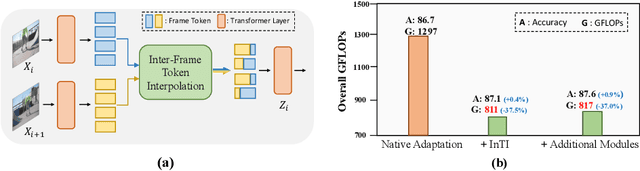

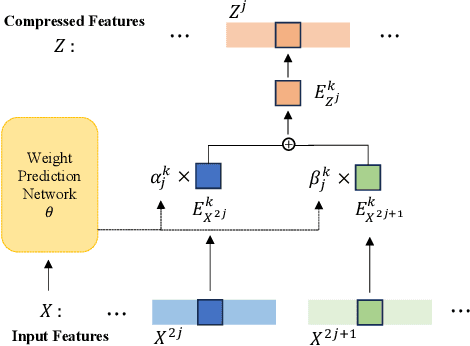

Recently, the remarkable success of pre-trained Vision Transformers (ViTs) from image-text matching has sparked an interest in image-to-video adaptation. However, most current approaches retain the full forward pass for each frame, leading to a high computation overhead for processing entire videos. In this paper, we present InTI, a novel approach for compressive image-to-video adaptation using dynamic Inter-frame Token Interpolation. InTI aims to softly preserve the informative tokens without disrupting their coherent spatiotemporal structure. Specifically, each token pair at identical positions within neighbor frames is linearly aggregated into a new token, where the aggregation weights are generated by a multi-scale context-aware network. In this way, the information of neighbor frames can be adaptively compressed in a point-by-point manner, thereby effectively reducing the number of processed frames by half each time. Importantly, InTI can be seamlessly integrated with existing adaptation methods, achieving strong performance without extra-complex design. On Kinetics-400, InTI reaches a top-1 accuracy of 87.1 with a remarkable 37.5% reduction in GFLOPs compared to naive adaptation. When combined with additional temporal modules, InTI achieves a top-1 accuracy of 87.6 with a 37% reduction in GFLOPs. Similar conclusions have been verified in other common datasets.
VFIMamba: Video Frame Interpolation with State Space Models
Jul 02, 2024Inter-frame modeling is pivotal in generating intermediate frames for video frame interpolation (VFI). Current approaches predominantly rely on convolution or attention-based models, which often either lack sufficient receptive fields or entail significant computational overheads. Recently, Selective State Space Models (S6) have emerged, tailored specifically for long sequence modeling, offering both linear complexity and data-dependent modeling capabilities. In this paper, we propose VFIMamba, a novel frame interpolation method for efficient and dynamic inter-frame modeling by harnessing the S6 model. Our approach introduces the Mixed-SSM Block (MSB), which initially rearranges tokens from adjacent frames in an interleaved fashion and subsequently applies multi-directional S6 modeling. This design facilitates the efficient transmission of information across frames while upholding linear complexity. Furthermore, we introduce a novel curriculum learning strategy that progressively cultivates proficiency in modeling inter-frame dynamics across varying motion magnitudes, fully unleashing the potential of the S6 model. Experimental findings showcase that our method attains state-of-the-art performance across diverse benchmarks, particularly excelling in high-resolution scenarios. In particular, on the X-TEST dataset, VFIMamba demonstrates a noteworthy improvement of 0.80 dB for 4K frames and 0.96 dB for 2K frames.